
Best Door/Window & Motion Sensors for Home Assistant (2026)
The best door, window and motion sensors for Home Assistant: fast, fully-local Zigbee and Matter picks for best overall, best value, best battery life and best motion. An independent, research-and-consensus roundup with a comparison table.
By HomeOS Lab · Last updated 3 September 2026
Some links on this page may be affiliate links. If you buy through them we may earn a small commission at no extra cost to you, and it never changes which products we recommend. See our affiliate disclosure.
Sensors are what turn Home Assistant from a fancy remote into a home that responds on its own. A contact sensor that fires the moment a door opens, a motion sensor that flips the lights on before you've reached for a switch: these are the parts every good automation is built from.
Two things separate a sensor worth mounting from one that will annoy you every day. It has to be fast and reliable, because a laggy or missed trigger breaks the illusion that the house is paying attention. And it has to run locally, because a sensor that checks in with a vendor cloud reacts slower and stops working the moment your internet drops. Every pick below runs on your own network over Zigbee or Matter/Thread.
This guide covers the door and window (contact) sensors and the motion and occupancy sensors we recommend for Home Assistant in 2026, with a pick for best overall, best value, best battery life, best motion, and the best Matter option for Thread-first homes. My bias, stated up front: for most people a handful of well-placed Zigbee sensors beat a houseful of Wi-Fi ones, and I would rather own fewer sensors that never miss than a drawer of cheap ones that keep dropping off the mesh.
How we chose: these picks rest on what matters for Home Assistant sensors, namely fully-local operation, trigger latency and reliability, battery type and how long a cell lasts, and first-class HA support across Zigbee and Matter/Thread. We weighed those against reports from the Home Assistant community and the relevant project docs. We're independent and reader-supported, so nothing here is paid placement, and we don't publish invented star ratings. Where we haven't put a specific unit through long-term first-hand testing, we say so and rank on the evidence rather than pretend otherwise.
What matters most in an HA sensor
Four things decide whether a sensor earns a place on your wall.
- Local control, which is non-negotiable. Prefer Zigbee or Matter-over-Thread. Both are local by design and report state to HA in milliseconds. Cloud-only Wi-Fi sensors route every trigger through a vendor server, which makes them slower and leaves them dead when your connection drops.
- Latency and reliability. For a contact sensor, "open" should reach HA effectively the instant it happens. For motion, what counts is a fast on and a sensible clear delay. A sensor that misses events or lags makes an automation feel broken.
- Battery type and life. Most contact and motion sensors run for a year or more on a coin cell (CR2032 or CR2450) or on AAAs. The battery type matters for replacement cost once you own a dozen of them. Zigbee sensors also lean on a healthy mesh to report reliably, so keep a few mains-powered routers nearby.
- PIR versus mmWave for motion. A classic PIR motion sensor is cheap and battery-powered, ideal for "someone walked in." An mmWave presence sensor detects that you're still there while you sit or work, but it usually needs mains power and costs more. Pick the one that fits the room; we cover dedicated presence sensors separately.
On Wi-Fi sensors: skip them for contact and motion duty. Battery Wi-Fi sensors drain quickly and add latency, and this whole category is where Zigbee and Thread pull ahead. If the only version you can find is a cheap Tuya Wi-Fi contact sensor, look for the Zigbee edition of the same hardware instead.
At a glance: the comparison table
| Sensor | Type | Protocol | Local control | Battery | Best for |
|---|---|---|---|---|---|
| Aqara Door & Window Sensor P2 (Editor's pick) | Contact | Matter-over-Thread / Zigbee | ✅ | CR2032 | Best overall contact |
| Sonoff SNZB-04 / SNZB-04P | Contact | Zigbee | ✅ (ZHA/Z2M) | CR2032 | Best value contact |
| Aqara Motion Sensor P1 | Motion (PIR) | Zigbee | ✅ (ZHA/Z2M) | CR2450 | Best motion (configurable) |
| Sonoff SNZB-03 / SNZB-03P | Motion (PIR) | Zigbee | ✅ (ZHA/Z2M) | CR2450 | Best value motion |
| Eve Door & Window (Matter) | Contact | Matter-over-Thread | ✅ | CR2450 (rechargeable) | Best Matter/Thread |
Best overall contact: Aqara Door & Window Sensor P2
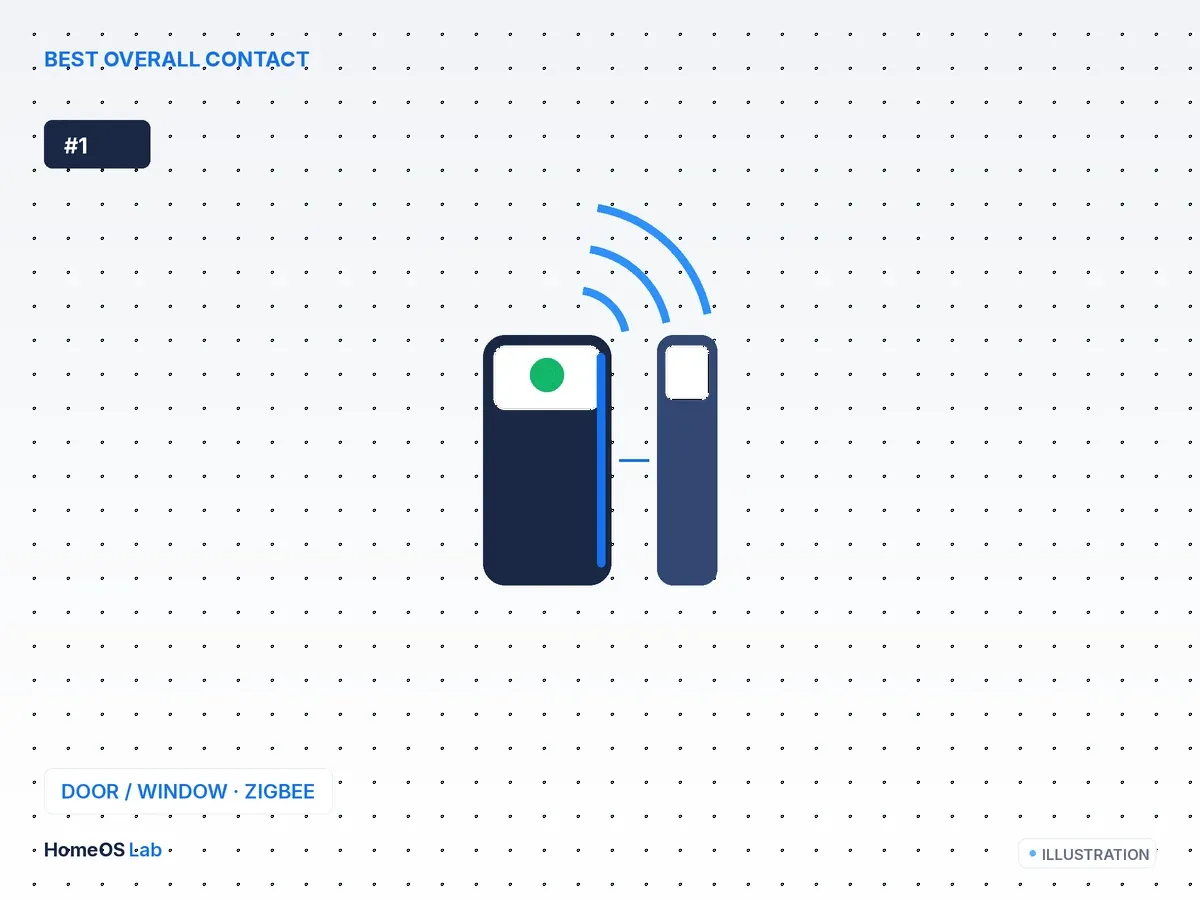
Aqara Door & Window Sensor P2
For most Home Assistant setups, the Aqara P2 is the contact sensor to beat.
- Type
- Contact (reed switch)
- Protocol
- Matter-over-Thread
- Local
- Yes, no cloud
- Battery
- CR2032
For most Home Assistant setups, the Aqara P2 is the contact sensor to beat. It's small enough to tuck discreetly onto a door or window frame, and it reports open and closed effectively the instant the state changes. Because it speaks Matter-over-Thread, it's local by design and won't be orphaned when your platform loyalties shift. Aqara's build quality sits a clear step above the generic no-name competition.
There are Zigbee variants too, which matter if you're standardising on Zigbee rather than mixing radios for a single sensor. The one thing to plan for is the border router: Matter-over-Thread needs a Thread border router on your network, so read our border router guide before you buy. If your home is all-Zigbee, get the Zigbee variant instead. For almost anyone building a modern HA install, the P2 is the door and window sensor I would reach for by default.
Best value contact: Sonoff SNZB-04 / SNZB-04P
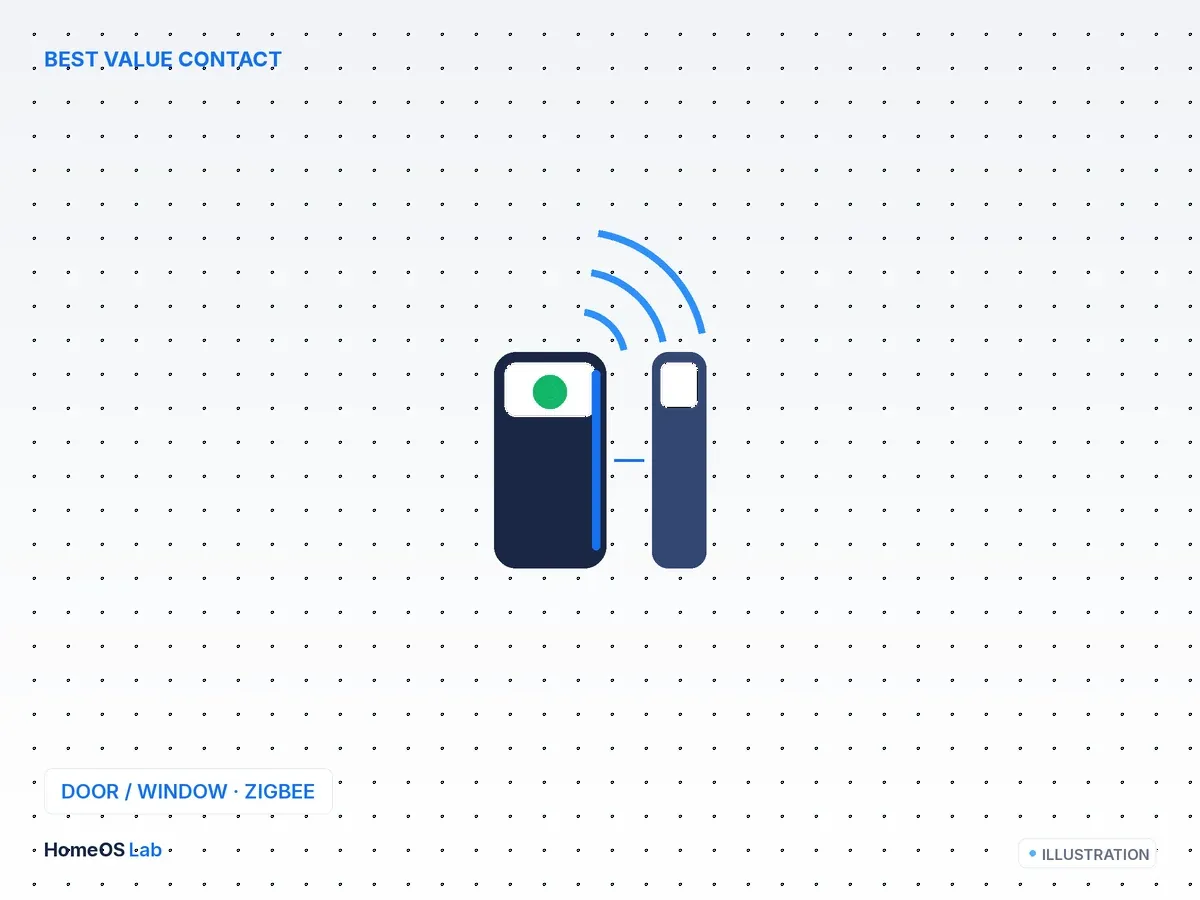
SONOFF SNZB-04
When you want to sensor-up every door and window in the house without spending a fortune, the Sonoff SNZB-04 and the newer SNZB-04P are the value pick.
- Type
- Contact (reed switch)
- Protocol
- Zigbee 3.0 (ZHA/Z2M)
- Local
- True
- Battery
- CR2032
When you want to sensor-up every door and window in the house without spending a fortune, the Sonoff SNZB-04 and the newer SNZB-04P are the value pick. This is a plain, dependable Zigbee contact sensor that pairs cleanly with ZHA or Zigbee2MQTT and reports quickly. It also costs little enough to buy by the handful, and the P revision improves range and battery reporting over the original.
One catch: the build is plainer than the Aqara, and like any Zigbee end-device the SNZB-04 wants a healthy mesh to report reliably at range. Scatter a few mains-powered smart plugs around as routers and it will hold its connection across a large home. For anyone kitting out a lot of openings on a budget, nothing else gives you this much reliable local coverage per dollar.
Best motion: Aqara Motion Sensor P1
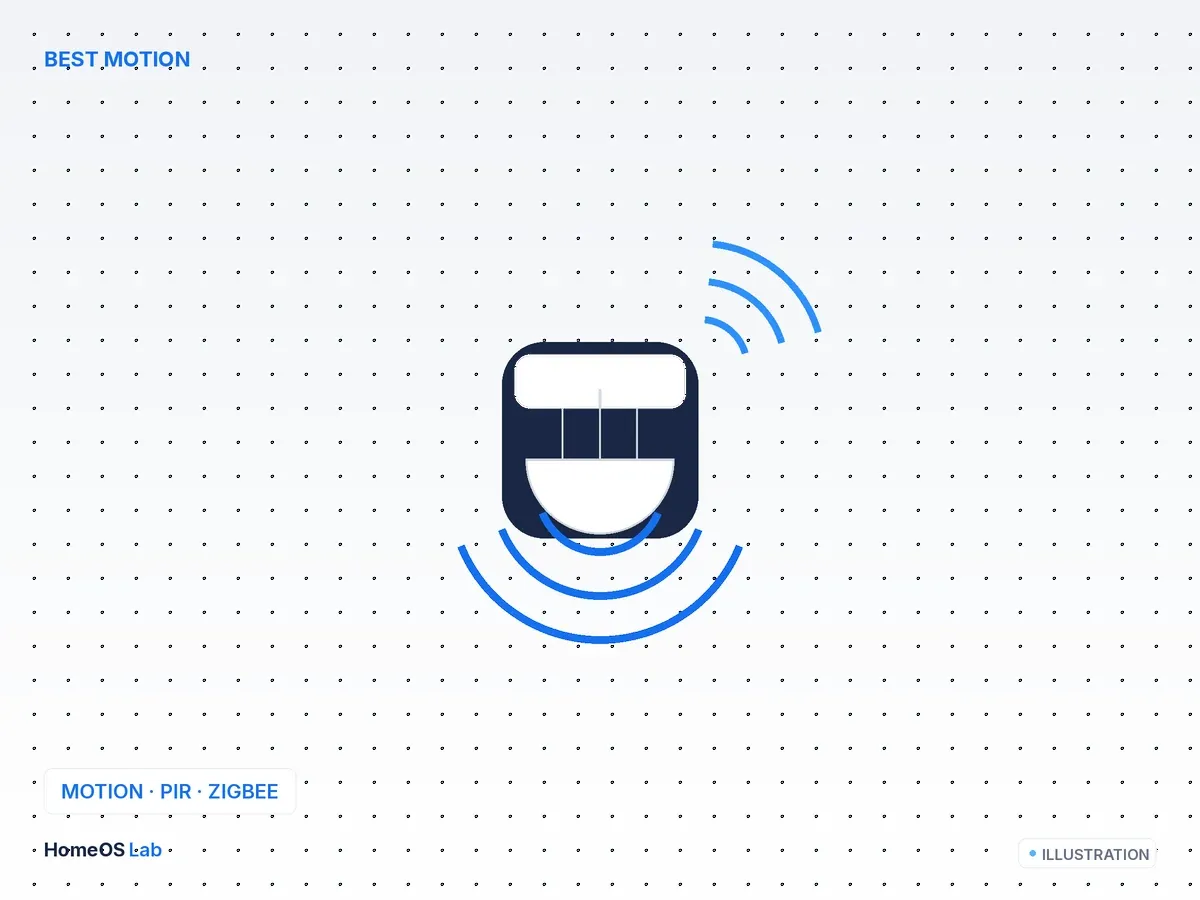
Aqara Motion Sensor P1
For the classic "someone walked in, turn the lights on" trigger, the Aqara Motion Sensor P1 is our motion pick.
- Type
- Motion (PIR)
- Protocol
- Zigbee 3.0 (ZHA/Z2M)
- Local
- True
- Battery
- CR2450, long life
For the classic "someone walked in, turn the lights on" trigger, the Aqara Motion Sensor P1 is our motion pick. It's a battery PIR that fires fast and runs a long time on a CR2450. It integrates cleanly through ZHA or Z2M, and what sets it apart from cheaper PIRs is control: you can adjust the clear/blackout interval, so you're not fighting a fixed timeout baked into the firmware.
- What to plan around: PIR detects movement, not presence, so it drops to clear while you sit still. When you need lights to stay on for a motionless reader, reach for an mmWave presence sensor instead (see our presence sensor guide (queue)).
- Worth pairing: add a lux or illuminance condition so the lights only fire when the room is dark. That single condition removes most of the "why did the lights come on at noon" complaints, and it costs nothing to set up.
The P1 earns its place in hallways, closets, bathrooms and entryways, anywhere movement should kick off an action.
Best value motion: Sonoff SNZB-03 / SNZB-03P
SONOFF SNZB-03
If you just want cheap, dependable motion triggers scattered around the house, the Sonoff SNZB-03 and SNZB-03P do the job for a fraction of what premium sensors cost.
- Type
- Motion (PIR)
- Protocol
- Zigbee 3.0 (ZHA/Z2M)
- Local
- True
- Battery
- CR2450
If you just want cheap, dependable motion triggers scattered around the house, the Sonoff SNZB-03 and SNZB-03P do the job for a fraction of what premium sensors cost. It's a no-frills Zigbee PIR that pairs easily and fires quickly, and the P revision adds configurable reporting along with better range.
You give up some of the tuning the Aqara P1 offers, and the same PIR-not-presence caveat applies: this sensor sees movement, not a still occupant. At range it wants the same healthy Zigbee mesh every battery sensor depends on. None of that is a dealbreaker when the goal is simple. To put motion coverage in every room without a cloud dependency, the SNZB-03 is the sensible default.
Best Matter/Thread: Eve Door & Window
Eve Door & Window
If you're standardising on Matter, the Eve Door & Window is the contact sensor to know.
- Type
- Contact
- Protocol
- Matter-over-Thread
- Local
- True
- Battery
- CR2450 (rechargeable)
If you're standardising on Matter, the Eve Door & Window is the contact sensor to know. It speaks Matter-over-Thread, so it's local by design and commissions straight into HA's Matter support without a vendor hub in the middle. Eve's build feels premium, and the newer units charge over a rechargeable cell rather than eating coin batteries.
- Needs: a Thread border router on your network before it will commission, the same as any Thread device.
- Skip it if: your home is committed to Zigbee. The Eve costs more than the Sonoff and Aqara picks, and its main draw is Matter-native, hub-free contact sensing for a Thread-first household or anyone deliberately steering clear of Zigbee.
How to choose in one line
- Want the best all-round door and window sensor? The Aqara P2.
- Sensoring the whole house on a budget? The Sonoff SNZB-04.
- After configurable, long-life motion? The Aqara Motion P1.
- Cheap motion in every room? The Sonoff SNZB-03.
- Building a Matter/Thread home? The Eve Door & Window.
- Need to detect that you're still there rather than just moving? See best presence/occupancy (mmWave) sensors (queue).
Related reading (the HomeOS Lab triangle)
- The radio your Zigbee sensors need: Best Zigbee coordinators for Home Assistant (2026).
- The border router your Matter sensors need: Best Thread border routers for Home Assistant.
- Make your sensors report reliably: scatter a few mains-powered smart plugs around as Zigbee or Thread routers.
- Presence versus motion, explained: Best presence/occupancy (mmWave) sensors for HA (queue).
- Choosing a protocol at all: Zigbee vs Z-Wave vs Thread vs Wi-Fi for Home Assistant.
FAQ
What's the difference between a motion sensor and a presence sensor?
A PIR motion sensor detects movement, which is great for triggering lights when you walk in, but it reports clear once you go still. An mmWave presence sensor detects that a person is there at all, even motionless, so the lights stay on while you read or work. PIR sensors are cheap and battery-powered, while presence sensors usually need mains power and cost more. Plenty of people run both, one for the trigger and one to hold the state.
Do these sensors work without the internet?
Yes. Every pick is Zigbee or Matter-over-Thread, both local protocols. They report to Home Assistant over your own network with no cloud round-trip, so they keep working, and stay fast, when your internet is down.
How long do the batteries last?
Most contact and PIR sensors run a year or more on a single coin cell such as a CR2032 or CR2450. Battery life depends on how often the sensor triggers and how strong your mesh is. HA can alert you when a cell runs low, so a dying battery never catches you out.
My Zigbee sensor keeps dropping off. Why?
Almost always a weak mesh. Battery sensors are end devices that rely on nearby mains-powered routers, such as smart plugs or bulbs, to relay their messages back. Add a couple of routers between the troublesome sensor and your coordinator and the drop-offs usually stop. Our smart plugs and reliable HA hub guides cover the layout.