
SONOFF ZBDongle-P review: the range workhorse for Zigbee2MQTT
An independent buyer's overview of the SONOFF ZBDongle-P (TI CC2652P) Zigbee coordinator for Home Assistant: specs, setup, range, pros and cons, and who it's for.
By HomeOS Lab · Buyer's overview · Last updated 3 September 2026
Some links on this page may be affiliate links. If you buy through them we may earn a small commission at no extra cost to you, and it never changes which products we recommend. See our affiliate disclosure.
Verdict: the ZBDongle-P is the coordinator to reach for when your Zigbee network is large or your house is big. It runs the Texas Instruments CC2652P with an onboard power amplifier and an external antenna, and that silicon has the longest, best-documented history in Zigbee2MQTT. The one limit is scope: it speaks Zigbee and nothing else, so a Thread or Matter path means adding different hardware.
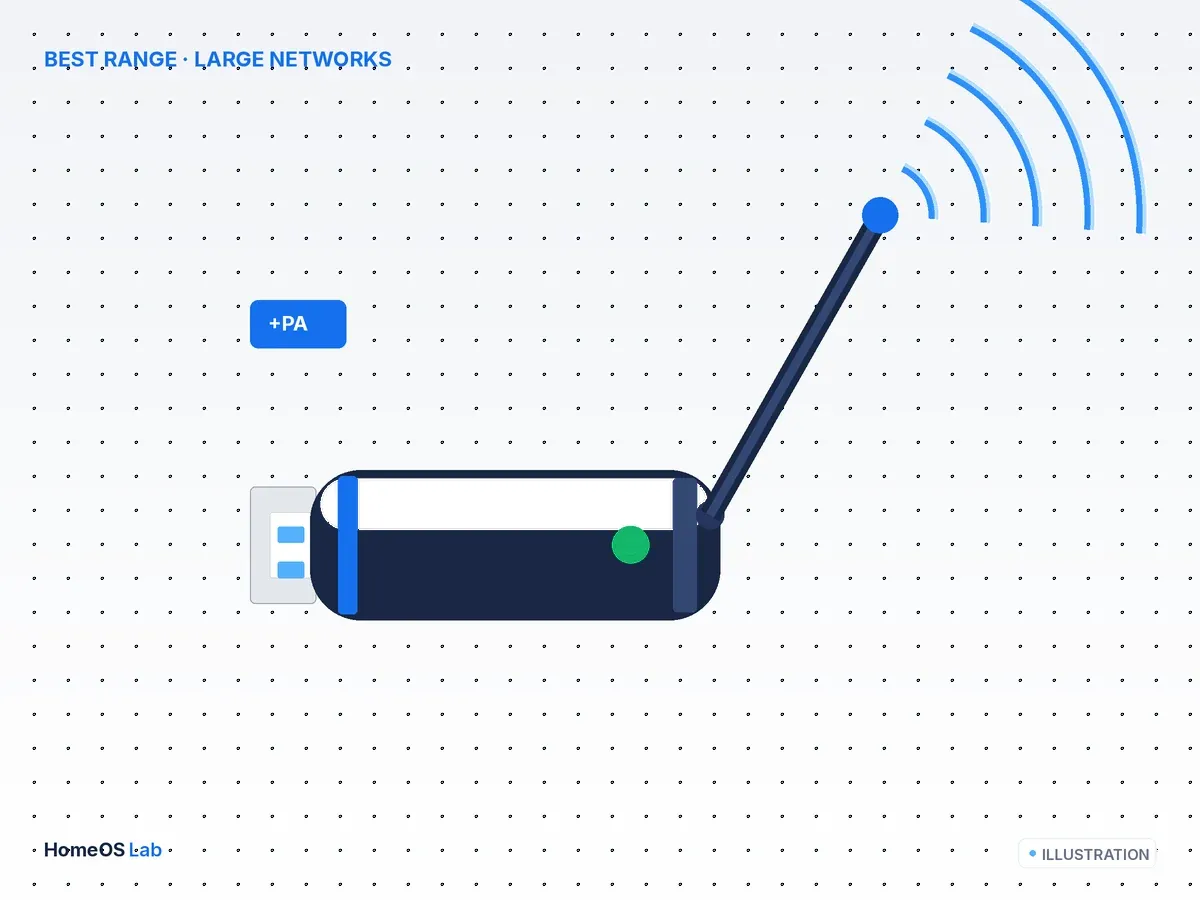
SONOFF ZBDongle-P
The ZBDongle-P is the coordinator to reach for when your Zigbee network is large or your house is big.
- Chipset
- TI CC2652P (+PA)
- Radios
- Zigbee 3.0 only
- Interface
- USB-A
- Antenna
- External
What it is
The SONOFF Zigbee 3.0 USB Dongle Plus, which almost everyone just calls the ZBDongle-P, is a USB-A Zigbee coordinator built on the Texas Instruments CC2652P. Two things separate it from a plain coordinator stick: an onboard power amplifier and an external antenna. The TI CC2652 family has been the backbone of Zigbee2MQTT for years, so its tested device list is enormous and its quirks are well understood by the community that maintains the project.
The power amplifier is the headline. It gives the radio more transmit power than an internal-antenna stick, and that extra push is what makes the ZBDongle-P the coordinator people keep recommending for meshes that run to many dozens of devices spread across a whole house.
One thing to get straight before you buy. Do not confuse the -P with the ZBDongle-E. The -P is the TI CC2652P. The -E is a Silicon Labs EFR32MG21, a different chip with a different firmware story. The -P is the range and large-network specialist; the -E is the newer value all-rounder (ZBDongle-E review).
Specs at a glance
| Chipset | Texas Instruments CC2652P (with power amplifier) |
| Radios | Zigbee 3.0, Zigbee-only (no Thread) |
| Interface | USB-A (extension cable recommended) |
| Antenna | External |
| Home Assistant stacks | Zigbee2MQTT (deep, mature support) and ZHA |
| Firmware | TI Z-Stack coordinator firmware; flashable/updatable |
Setting it up in Home Assistant
Setup is standard for a TI coordinator, with one physical step that matters more than newcomers expect.
- Put it on a USB extension cable. Home Assistant's ZHA documentation recommends keeping any Zigbee coordinator away from the host machine and off USB 3.0 ports, because USB 3.0 is a documented source of 2.4 GHz interference that shows up as flaky pairing and dropped devices. A short extension lead solves it and lets you position the external antenna sensibly.
- On Zigbee2MQTT, point Z2M at the stick's serial port and select the TI
zstackadapter. This is the path the CC2652P is best known for, and it is the most thoroughly documented coordinator in the Z2M project. - On ZHA, the same stick works through the TI
znpradio type. If you would rather use Home Assistant's built-in Zigbee integration than run Z2M, nothing here holds you back. - Firmware: the -P ships with TI Z-Stack coordinator firmware and works out of the box. The chip is flashable, and keeping the Z-Stack firmware reasonably current is the usual community advice for large-network stability.
Why it earns the range reputation
Two design choices explain the reputation, and both hold up on the spec sheet and in community consensus rather than in any bench claim we can make ourselves.
The first is history. The CC2652P carries the deepest track record in Zigbee2MQTT of any coordinator silicon, which in practice means the widest list of devices that other people have already paired and reported working. When a new sensor lands support, it tends to land on this chip early.
The second is raw reach. Pairing a power amplifier with an external antenna gives the ZBDongle-P more transmit headroom than internal-antenna sticks, which is what a sprawling mesh wants from the one radio sitting at its centre. That is why it comes up so often for homes with a detached garage or far bedrooms, where a coordinator tucked next to the server would otherwise strain. Range still depends on your router devices and your walls, so no coordinator alone fixes a thin mesh. On the coordinator side of that equation, though, this is about as strong as budget Zigbee hardware gets.
Pros and cons
What it does well:
- The power amplifier and external antenna give it more transmit reach than internal-antenna coordinators.
- The CC2652P has the most tested history in Zigbee2MQTT, so device compatibility is broad and predictable.
- It runs well on both Zigbee2MQTT and ZHA, so you are not locked into one stack.
- You get that range at a coordinator-tier price rather than a premium one.
Where it gives ground:
- It is Zigbee-only. There is no Thread or Matter-over-Thread path, so if that sits on your roadmap you will want the Connect ZBT-1 plus a separate border router.
- It leans a little more toward tinkerers than the official ZBT-1, mostly because of the firmware-flashing culture around TI chips. The factory coordinator firmware does run fine as shipped, so this is a lean rather than a flaw.
- The connector is USB-A only.
Who should buy it
This is the stick for Zigbee2MQTT power users and for anyone wiring up a whole-house mesh that will keep growing past a handful of devices. If range is your main frustration and you have already decided Thread is not on your list, the ZBDongle-P is the most proven and most compatible Zigbee radio you can put at the centre of that network without paying a premium.
The one honest reason to look elsewhere first: if you are early enough that Matter-over-Thread might tempt you later, buy for that future instead of this one.
Alternatives (the HomeOS Lab triangle)
- The official pick with a Thread and Matter path: Home Assistant Connect ZBT-1 review, built on the EFR32MG21.
- The value pick: SONOFF ZBDongle-E review, an EFR32MG21 stick with an external antenna that usually costs less.
- The full comparison: Best Zigbee coordinators for Home Assistant (2026).
- Choosing a protocol first: Zigbee vs Z-Wave vs Thread vs Wi-Fi for Home Assistant.
FAQ
ZBDongle-P or ZBDongle-E?
Pick the -P (TI CC2652P with power amplifier) for maximum range and large Zigbee2MQTT networks. Pick the -E (Silicon Labs EFR32MG21) for value and ZHA-friendliness. The -P is Zigbee-only. The -E's silicon is Thread-capable but used mostly for Zigbee in practice. If a Thread path is the goal, get the Connect ZBT-1 instead.
Does the ZBDongle-P support Thread or Matter?
No. It is Zigbee-only. Use it for Zigbee and add a separate Thread border router, such as a Connect ZBT-1 running Thread firmware, if you need Matter-over-Thread.
Is it better on Zigbee2MQTT or ZHA?
Both work fully. The CC2652P has its deepest history and largest community on Zigbee2MQTT (the zstack adapter), which is why Z2M power users favour it, but ZHA supports it through the TI znp radio type just as completely.